

Wordful: Word Connect Game
AERO ISLE INC
I enjoy word games most when they give me something to focus on without turning a quiet break into a demanding competition. Wordful: Word Connect Game fits that mood well. It is a free word game from AERO ISLE INC built around arranging letters into words, with a calm nature setting and movement across eight directions. I found it easy to start, but not so shallow that every round felt automatic.
The important question is not whether it has the biggest feature list. It is whether this particular style of puzzle suits the way you like to play. If you want a gentle mental workout, short sessions, and a board that rewards looking at letters from more than one angle, I think it is worth trying. If you prefer a dictionary-heavy word challenge, competitive rankings, or a fast match against another person, a different type of word game may serve you better.
How I judged the game before recommending it
My first decision criterion was the basic puzzle loop. A word game needs to make its rules understandable almost immediately, while still leaving room for observation and deduction. Here, the central idea is straightforward: connect letters to form words, with paths that can bend in eight directions. That extra movement matters because it makes the board feel less like a simple horizontal word search.
I also paid attention to the rhythm of play. Wordful is better suited to a relaxed pause than to a frantic session. I could pick it up while waiting for an appointment, play a few puzzles, and stop without feeling that I had abandoned a long multiplayer match. That makes it a useful choice for people who want a small daily habit rather than a game that takes over their attention.
The third criterion was how much thought the board asks from me. The game does not depend only on knowing unusual vocabulary. It also tests whether I notice possible letter routes, recognize familiar word shapes, and avoid committing too quickly to the first answer I see. In practice, this gives the puzzles a nice balance: vocabulary helps, but visual scanning and patience help just as much.
Related News

Threads in Real Life: Who Should Join, Lurk, or Leave

How SHEIN Turned Shopping Into an Endless Content Feed

How to Make Fortnite Feel Smarter on Mobile

Should You Switch to Microsoft Outlook on Mobile?

Why Gallery Keeps Pulling Users Back

X Review: Why Its Network Still Matters
Its presentation also affects the decision. The serene nature theme supports the slower pace, and I found that the setting matches the kind of concentration the puzzles encourage. It is not merely decoration in my experience; it helps the game feel like a quiet reset instead of another noisy phone task.
There is also a practical reason to consider it. The game is free to download and is rated for Everyone, so it is approachable for a broad audience. It has reached over 500 thousand installs and holds a 4.5 average from around 20 thousand ratings, which suggests that the simple word-puzzle format has found a substantial audience without requiring a specialized interest in competitive gaming.
The first few sessions: simple rules, more visual depth than expected
My first impression was that the game explains itself through interaction rather than a long tutorial. The board gives me letters, and I explore connections to build words. Because movement can go in eight directions, I have to think about diagonals and turns instead of scanning only from left to right. That small rule change gives the game its identity.
Gallery
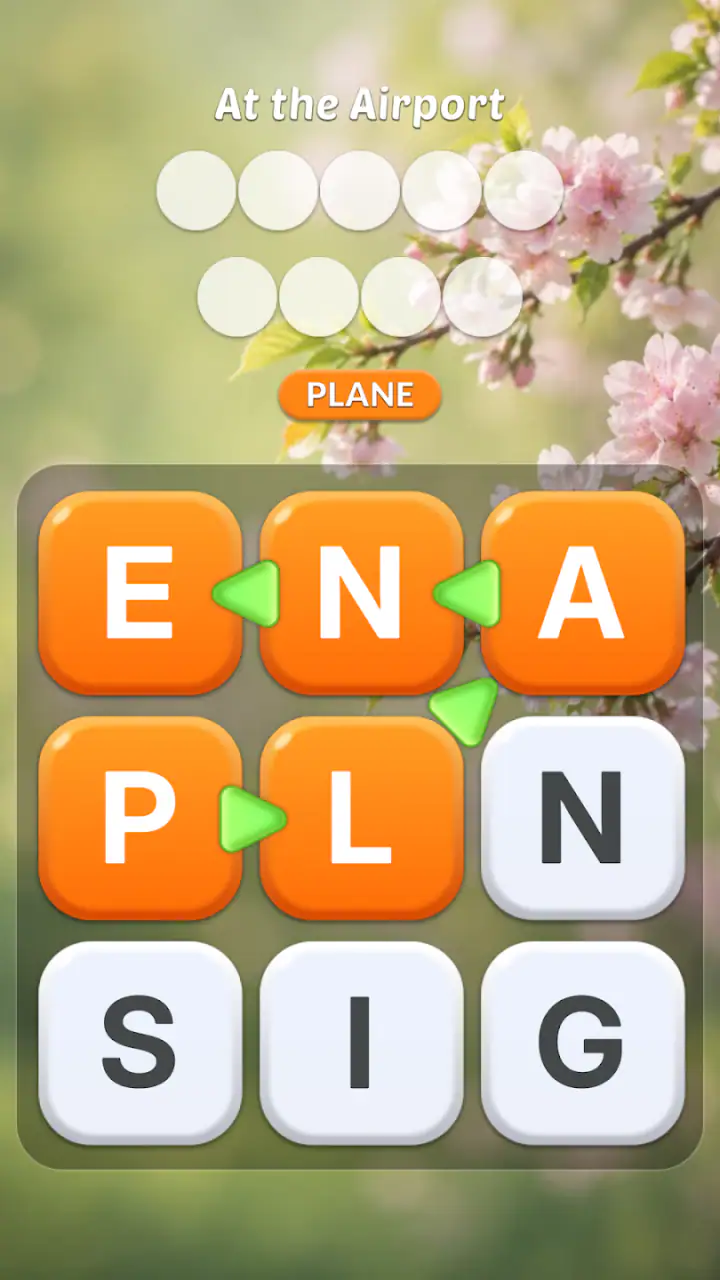
I quickly learned not to treat the most obvious word as the end of a puzzle. After finding a familiar answer, I started checking the surrounding letters for another route or a shorter combination. This is one of the more useful habits the game encourages: look at the unused letters after solving the obvious word. It turns a quick guess into a more deliberate search and can make an otherwise easy board feel more rewarding.
The controls are naturally suited to touch. Connecting letters feels more direct than tapping separate tiles, and the gesture keeps the attention on the board. I did notice that a player who prefers precise, menu-driven interaction may need a brief adjustment, especially when moving diagonally or changing direction quickly. For me, the gesture became comfortable once I stopped trying to rush it.
Why the eight-direction design changes the puzzle
Many familiar word games train me to search in rows, columns, or a fixed order. Wordful asks for a wider visual scan. A word can turn, travel diagonally, and use a route that is easy to overlook when I am searching with a rigid pattern in mind. The result is a puzzle that feels more spatial than a standard anagram exercise.
This creates an interesting trade-off. Players with strong vocabulary may still get stuck if they do not inspect the board carefully, while players with ordinary vocabulary can often progress by identifying likely letter sequences and tracing them patiently. I appreciate that distinction because it rewards a learnable skill rather than only a large word bank.
A practical technique helped me most: I began by locating common beginnings and endings, then followed nearby letters in every direction. Instead of trying to invent a word from the whole board, I used visible combinations as anchors. This is especially useful when a puzzle looks crowded. It reduces the feeling of staring at random letters and gives the search a repeatable method.
Another useful approach is to change the direction of my attention when I stall. I might first inspect diagonals, then switch to possible turns around a central letter. That sounds minor, but it prevents the common word-game problem of repeatedly searching the same mental path. The board stays the same; my viewing strategy changes.
Where the calm presentation genuinely helps
The natural scenery and quieter atmosphere are a good match for the game’s purpose. I would not describe the presentation as the main reason to play, but it helps separate Wordful from word games that constantly push urgency, competition, or visual noise. When I use it late in the day, the softer mood makes it easier to play a few rounds without feeling overstimulated.
That calm tone also makes the game suitable for shared, low-pressure use. I can imagine passing the phone to a family member and solving a board together, with one person spotting a route and the other suggesting possible words. Since the rules are easy to understand, the game does not require a long explanation before someone else can join the conversation.
Still, the relaxed presentation will not satisfy everyone. If you want flashy effects, a strong sense of progression, or constant competitive pressure, the same calmness may feel too restrained. I see that as a design choice rather than a flaw, but it is an important choice to make before downloading.
Where Wordful wins, and where another word game may fit better
The strongest fit: short, quiet mental exercise
Wordful works best for someone who wants a compact puzzle that exercises attention without demanding a long uninterrupted session. I found it particularly comfortable during small gaps in the day: a coffee break, a commute when I was seated, or a few minutes before bed. The board gives me something meaningful to solve, but the game does not require the commitment of a full strategy session.
It is also a strong option for players who enjoy visual word finding more than pure anagram solving. In an anagram game, I may spend most of my time rearranging letters mentally. Here, the route itself matters. I am solving both a language problem and a spatial problem, which gives the experience more variety than simply producing as many combinations as possible.
Families may appreciate the Everyone age rating and the accessible rules. I would still recommend that younger players treat unfamiliar words as learning opportunities rather than assume every answer is obvious. The game can encourage discussion about spelling and vocabulary, especially when two people see different possible paths.
It is also useful for people who dislike losing progress because they play irregularly. A puzzle that can be approached in small pieces feels less punishing than a game built around maintaining a daily competitive streak. That makes it easier to return after a break without needing to remember a complicated system.
When a conventional word search is the better choice
If your favorite part of word games is scanning a clean grid for words in straight lines, the eight-direction bending mechanic may feel less familiar than a traditional word search. Wordful adds flexibility, but that flexibility also removes some of the neat visual order that traditional players enjoy.
A conventional word search may be better when you want a clearly defined hunt with fewer route decisions. It can feel more predictable and may be easier to play while distracted. Wordful asks me to stay more engaged with the shape of the path, so it is not always the best companion for multitasking.
When an anagram or spelling game is the better choice
Anagram-focused games are a better match if you want vocabulary generation to be the main challenge. They usually make the letter pool the star, while Wordful makes the board layout equally important. I prefer Wordful when I want a visual puzzle, but I would choose an anagram format when I am specifically trying to test how many words I can build from a fixed group of letters.
Players studying a language should also think about their goal. Wordful can encourage recognition of words and spelling patterns, but it is not the same as a structured language course. Someone who needs pronunciation practice, grammar explanations, or organized vocabulary lessons should choose a dedicated learning app instead. This game can support casual exposure, not replace instruction.
When competitive alternatives are more suitable
Wordful is not my first recommendation for someone whose motivation comes from live opponents, leaderboards, or timed pressure. Its appeal is the individual puzzle and the calm pace. A competitive word game will provide a stronger sense of rivalry and urgency, while this one is more comfortable for private concentration.
That difference affects replay value. I can return to Wordful because I enjoy the solving process, but players who need social comparison to stay interested may lose motivation sooner. If your ideal session involves challenging a friend in real time, look for a game designed around that interaction rather than expecting this quiet format to provide it.
Small frictions I noticed during regular use
The simple design is mostly an advantage, but it also means the experience may feel limited to players who want layers of customization. The central activity remains word connection, and the nature setting supports it without transforming it into a larger adventure or strategy system. I would not install it expecting a broad collection of unrelated modes.
There is also a possible vocabulary frustration. A player may see a route that looks promising but not immediately recognize the word it forms. That can be satisfying when the answer finally clicks, but it can also make a puzzle feel less transparent than a purely visual matching game. I recommend approaching those moments as vocabulary discovery rather than assuming the board is poorly designed.
The game includes optional in-app purchases priced from $0.99 to $99.99 per item. Since the game itself is free, I would start without spending anything and decide based on how often I play and whether the optional purchases solve a real annoyance for me. Casual players can evaluate the core experience first instead of treating payment as part of the entry requirement.
For compatibility, the current version is 8.3.11 and the game requires Android 7.0 or later. That is worth checking before installing, particularly if you use an older phone. On a supported device, the modest puzzle format is a sensible fit for quick play, but I still prefer keeping the app updated so the experience matches the current release.
What switching from another word game feels like
The cost of switching is low if you already understand basic word-game habits. You do not need to learn a complex economy, a large character roster, or a new control scheme. The real adjustment is mental: stop searching only in straight lines and start treating the board as a network of possible turns.
Players coming from anagram games may initially overvalue the letters and undervalue their positions. I had better results once I asked two questions in order: what words might exist, and which of those words can actually be traced through neighboring letters? That separation makes the game feel clearer and prevents me from wasting time on words that the board cannot support.
Players coming from traditional word searches may have the opposite adjustment. They may see the grid efficiently but hesitate when a word bends. I found that deliberately checking one diagonal and one corner route on each board helped me become comfortable with the movement without turning every puzzle into a slow inspection.
The good news is that the transferable skill is attention, not memorization of a special rulebook. After a few sessions, I naturally began checking routes more broadly. That makes Wordful easy to add alongside another word game rather than forcing a complete replacement.
A realistic everyday scenario
Imagine having ten minutes before leaving for work. You want something more engaging than scrolling, but you do not want to begin a game that will punish you for stopping midway. Wordful fits that moment: open a board, trace a few words, pause when the time is up, and return later when you want another quiet challenge.
Another good scenario is a shared screen during a relaxed evening. One person can look for possible words while another follows the routes. The eight-direction system gives both players something to discuss because the answer is not only “which word?” but also “can those letters connect in that order?” That makes the puzzle more conversational than a solitary vocabulary test.
I would be less likely to choose it during a busy commute when I need constant stimulation or when I want a definite competitive result before reaching my destination. Its strengths appear when I can give the board a little attention and enjoy the process rather than rush to finish.
My recommendation after weighing the trade-offs
I recommend Wordful to anyone who likes word puzzles with a visual twist and prefers a calm, flexible pace. The combination of connected letters, eight-direction movement, and nature-themed presentation gives it a clear personality. It is approachable enough for a first-time word-game player, yet the board routes provide more thought than the short store summary might suggest.
I would especially recommend it for casual players, families looking for an easy shared puzzle, and people who want a small mental break without timers or live competition defining the experience. The fact that it is free makes testing that fit straightforward, while the Everyone rating keeps the entry point broad.
I would skip it if your priority is advanced vocabulary training, formal language learning, multiplayer rivalry, or a large set of radically different game modes. In those cases, a dedicated alternative will be more precise. Wordful is not trying to be all of those things, and judging it by those standards would miss what it does well.
For me, the deciding strength is the way it turns ordinary word finding into a gentle spatial puzzle. I can play slowly, use a repeatable search method, and still feel that each solved board came from paying attention rather than tapping through possibilities. That is a modest idea, but it is executed in a way that makes the game easy to return to.
After trying it, my advice is simple: install it when you want a quiet word challenge, begin by checking diagonal routes, and resist the urge to stop after the first obvious answer. Give the board a few unhurried minutes. If that style of discovery feels satisfying, Wordful is a dependable addition to a casual puzzle collection. If you need competition or structured learning, keep looking for a more specialized fit.
FAQs for Wordful: Word Connect Game
What is Wordful: Word Connect Game?
Wordful: Word Connect Game is a casual word puzzle app built around connecting letters to form hidden words. It is designed for short sessions as well as longer play, with progressively more challenging levels that test vocabulary, spelling, and pattern recognition. The straightforward controls make it accessible to most players, while the increasing difficulty keeps the gameplay engaging over time.
How do you play Wordful: Word Connect Game?
To play, you generally swipe across or tap letter tiles to create valid words and complete each puzzle. The objective is to discover the required words using the available letters, sometimes including bonus words that can provide extra rewards. As levels advance, puzzles may become less obvious, so experimenting with different combinations and using the available hints can be helpful when you get stuck.
Is Wordful: Word Connect Game free to download and play?
Wordful: Word Connect Game can typically be downloaded and played without an upfront purchase, making it easy to try on a compatible Android or iOS device. However, free puzzle games commonly include optional in-app purchases, such as hint packages or other bonuses, and may display advertisements. Check the store listing and in-game purchase settings before downloading if you want to manage costs carefully.
Does Wordful: Word Connect Game work offline?
Many of the core word puzzles may be available without a constant internet connection, which is useful when traveling or playing where mobile data is limited. Nevertheless, certain features—such as advertisements, cloud synchronization, updates, leaderboards, or purchases—may require internet access. Availability can also depend on the current app version, so it is worth testing a level offline after installation.
Is Wordful: Word Connect Game suitable for children and beginners?
The simple word-connecting format makes Wordful suitable for beginners and casual players who enjoy relaxed brain-training games. It can also help younger users practice spelling and vocabulary, although the difficulty and word selection may vary by level. Parents should review the app’s age rating, advertising, privacy information, and purchase controls before allowing children to play independently.
Pros
- Simple swipe controls make it easy to start playing immediately.
- Short levels fit well into commutes
- breaks
- and quick gaming sessions.
- Progressive difficulty keeps later puzzles more challenging.
- Helpful hints can prevent players from getting stuck for too long.
- Offline play makes it convenient when an internet connection is unavailable.
Cons
- Some puzzles may accept only one expected word or spelling variation.
- Hint availability can become limited without watching ads or spending currency.
- Repeated level patterns may feel familiar to frequent word-game players.
- The game can become more difficult if your vocabulary is limited.
- Advertising may interrupt the experience between puzzles or level attempts.


